
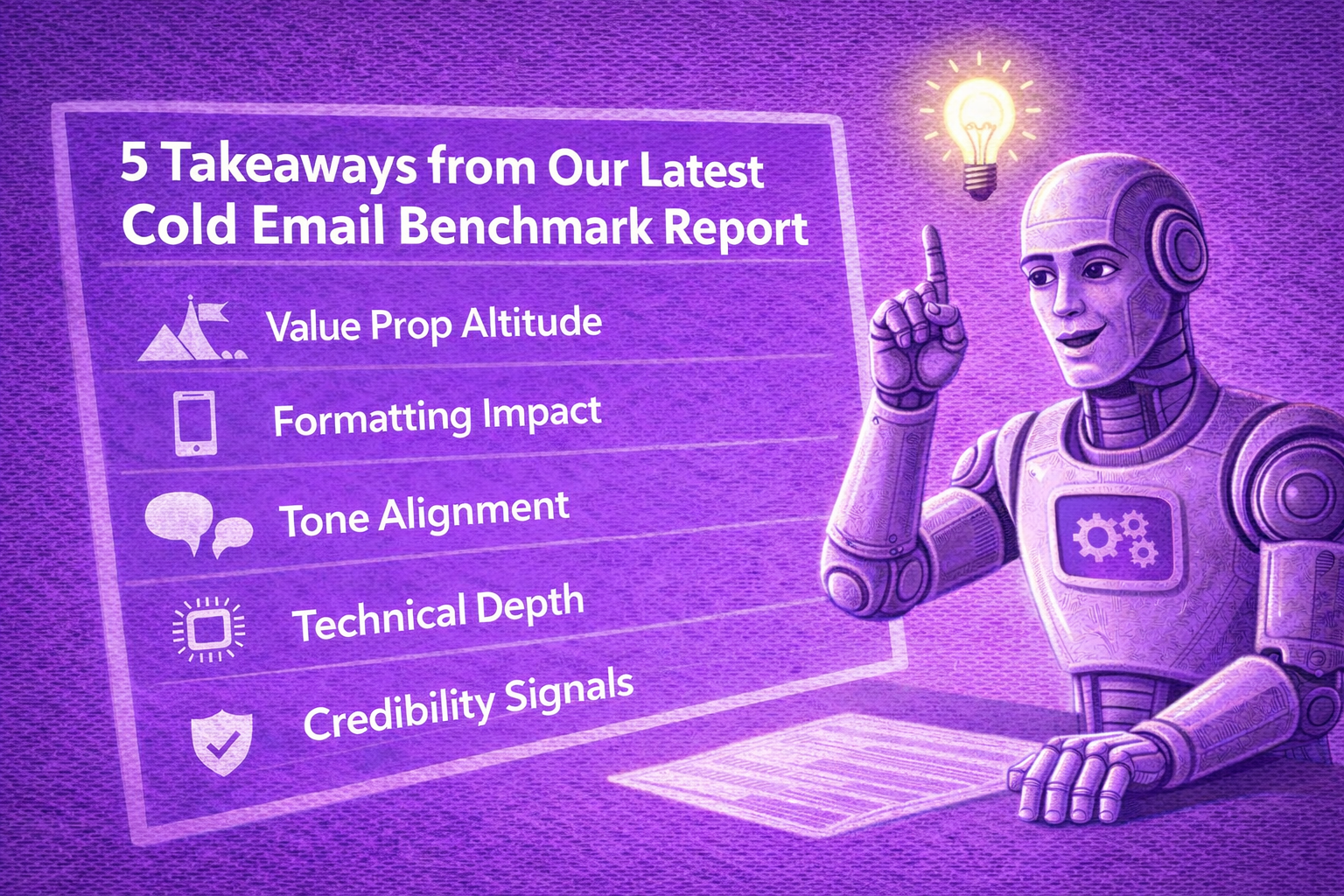
5 Takeaways from Our Latest Cold Email Benchmark Report
If you've followed Lavender over the years, we love to publish best practice data on cold emails. In our most recent cold email benchmarking report, we took this a few layers deeper.
You see, most best practice data is shared at the aggregate level. So you're learning a best practice that might be muddied by what's working for someone in an entirely different industry. To help with this, we analyzed 231,818 cold emails across ~50,000 inboxes.
The goal wasn’t to produce more generic advice.
It was to understand why some emails perform — and why others don’t — across departments, seniority, and industries.
You can learn more in the report itself. But, if your cold emails aren’t getting replies, here are five data-backed reasons that might explain it.
1. Seniority: frame value to match the altitude
The data shows that different levels of seniority are more responsive based on how you frame your value:
- Executives (CSuites & VPs) respond to company-level strategy and timing (revenue, cost, risk).
- Senior leaders engage at the department level (ideally specific use-cases)
- Managers respond to tactics > strategy (clear practical applications)
- Individual contributors care about outcomes tied directly to their work.
If your emails aren’t landing, it may not be the offer. It might just be that you're talking about a tactical application to an individual contributer who wants to know how it's going to impact the KPIs they're measured on. It might be that you're talking to an executive about department level usecase. It might be that you're talking to a manager about a strategy they don't control.
Align the value to the altitude.
2. Mobile formatting matters... for some more than others
The data shows that overall we love clean, mobile-friendly emails. It produces 83% more replies on average. This is largely because an email's first impression is 8x more likely to happen on mobile.
So formatting does matter. But, it's not equal across roles.
Mobile-optimized emails are more impactful when sent to:
- Sales
- Product
- Marketing
- Operations
- Individual contributers and frontline managers
Formatting had less measurable impact for:
- Engineering
- Research
- Facilities
- Finance
- Legal
- HR
- PR
If you’re selling into sales, marketing, or product and your email feels dense, that may be suppressing replies.
If you’re selling into legal or research, formatting tweaks alone likely won’t move the needle.
3. Match your tone to the personality of the department
Tonality in writing is a tricky thing to coach, but how you match it to the reader can significantly change your response rates.
Here’s a summary of the tones that worked best by department:
- HR prefers warm and friendly. Like a text from a long time friend. Anything "transactional" or cold pushes them away.
- Marketing leans casual. But...
- PR leans more professional
- Sales prefers concise and direct language.
- Facilities skew more professional.
- Legal & Finance want precision and matter-of-fact language.
- Researchers respond to measured, restrained communication.
If you’re not seeing replies, it may not be your pitch.
It may be that your tone doesn’t match how that function processes information.
Over-excitement turns researchers away.
Hype pushes finance out.
Transactional language loses HR.
Subtle differences. But, a good takeway would be to mirror the energy your prospects bring to calls with you.
4. "Technical Buyers" might not like you getting “technical”
Getting technical seems like an easy way to build credibility. But, depending on your persona and how you communicate it, you could be turning buyers away. While there was no significant evidence for many of the personas you can be targeting, 3 stood out:
- Engineering wants you to get technical.
- Product (surprisingly) does not. They want you to speak to broader roadmap initiatives > any specific technical details.
- HR (not surprisingly) does not.
But here’s the kicker:
Technical jargon turns engineers away.
What performs better is speaking to a a specific use case or workflow in language you understand.
(This was also true for operations.)
If your message feels inauthentic, you lose engineers. Throwing language at engineers because it "feels" like the right terms to use is the fastest way to get them to check out.
Clarity and authenticity beats complexity for the sake of credibility.
Ditch the website lingo. If you can't explain it clearly, you might not understand the specific technicalities well enough.
5. Credibility isn't as simple as name dropping a case study
Credibility matters, but how you communicate that proof varies.
Departments that respond strongly to explicit proof from a specific customer include:
- Operations
- Marketing
- Research
- Product
- Legal
These groups want to hear who has succeeded and what happened.
But going overboard on name drops can turn Finance buyers away. (They don't like the hype)
Meanwhile, for personas like:
- Sales
- Engineering
- & Facilities
Credibility is built through a clear understanding of the use case. This matters more than logos.
There's a deeper pattern that should be applied whether you name a customer or not:
Operations wants to see which process becomes more efficient.
Marketing wants you to acknowledge their campaigns and pipeline.
Product wants you to understand themes in their roadmap.
Proof helps. But, proof without relevance doesn’t convert.
The best framework for bringing this to life continues to be the BAR framework we published years ago. Contextualizing stories with a simple storytelling framework that covers the background, actions and results. Whether you name drop anyone specific is up the persona you're targeting.
The Throughline
Across 231,818 cold emails, one theme shows up repeatedly:
Cold email performance isn’t universal. It varies based on the industry, their role and their seniority.
It’s contextual.
If you’re not seeing replies, it may not be that your messaging is “bad.”. It just might be that your message isn't aligned with:
- their seniority
- their department
- their personality (tone)
- their technical depth
- or preferences for proving credibility.
The better you match the reader’s lens, the more likely you are to earn a response.
If you want to explore the full benchmarking data, the Cold Email Benchmark Report is live on our blog.
And if you’re trying to operationalize this kind of alignment at scale, check out what Lavender can do for you.