
AI and the Future of Software: Why SaaS Isn’t Dying, but Its Value Is Being Rewritten
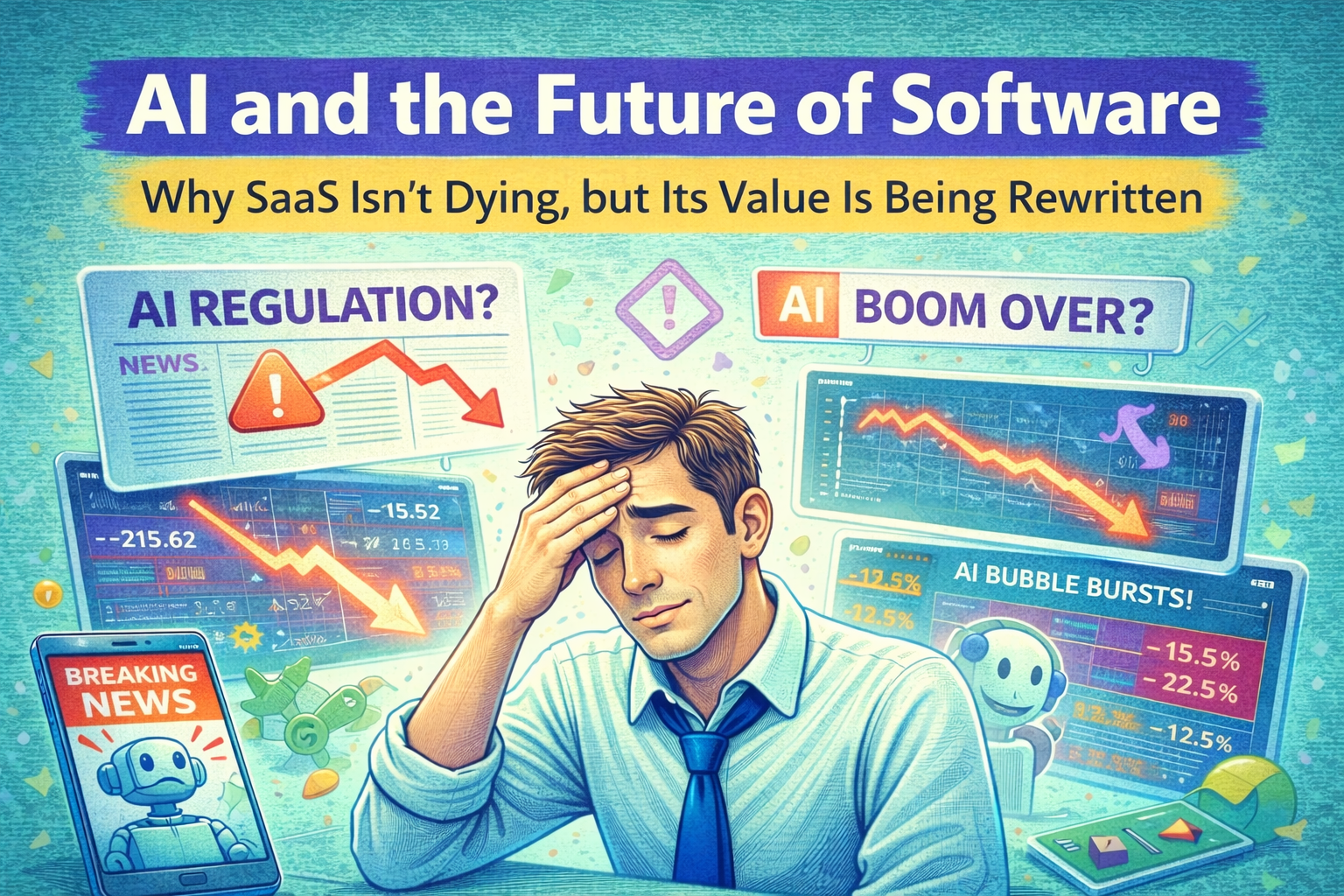
Every week there’s another “new” AI update.
Another model. Another workspace. Another agent. Another demo that feels impressive in isolation but hard to place in the bigger picture.
If you're wresting with the constant drumbeat, you've probably noticed it's doing something subtle but important.
It’s driving a not-so-quiet repricing of expectations around software.
I’m not someone who thinks SaaS is going anywhere.
But I do think AI is changing what software is, how it’s used, and where its value lives.
Two ideas have helped me make sense of this shift more than anything else: Aggregation Theory and The Platform Delusion. Together, they explain why agent work reshapes software in a way most “AI features” miss entirely.
Aggregation Theory, and Why It Still Matters
Aggregation Theory was developed and popularized by Ben Thompson at Stratechery. The core idea is straightforward.
If you aggregate demand, you gain leverage across the value chain.
Google owns search.
Facebook owns the social feed.
Amazon owns commerce.
Once you control the point of aggregation, everything downstream bends toward you. Most notably ad revenue. Pricing power shifts. Margins move. Defensibility emerges.
What’s changing now is not the importance of aggregation.
It’s who or what is doing the aggregating.
AI agents are becoming an aggregating force.
They take over the work humans used to do.
They decide which systems to pull from.
They execute across tools on our behalf.
AI calls your Uber.
AI “calls” Airbnb to find the right place to stay.
The role of the user changes. The agent becomes the decision-maker. And that shifts the leverage point away from interfaces and toward the systems agents rely on for context and execution.
The Platform Delusion
The Platform Delusion, by Jonathan Knee, pokes at the assumed defensibility of many modern tech platforms. The book challenges the idea that being a platform automatically creates a moat.
Knee’s argument points to something fundamental.
The true moat is not the platform itself, but the data behind it.
In a world where AI can generate code endlessly, interfaces can be copied, marketplaces can be recreated.
But deep, proprietary context is harder to replicate.
AI agents stress-test this idea.
Agents don’t care about UX.
They don’t browse.
They don’t get locked into workflows the way humans do.
They care about access to reliable context so they can get their job done.
This is why the future of software isn’t teams “vibe coding” a new CRM. Building and maintaining that slice of the context layer isn’t where the value accrues. The value shifts to what the system knows and how useful that knowledge is to an agent operating across multiple systems.
Open to Agents or Closed to Sharing Context
This is the real fork in the road for software companies.
In an agent-first world, the key question isn’t “Do you have an API?”
It’s whether your system is willing to share context in a way agents can actually use across tools.
The famous investor Bill Gurley described it as supporting "open data" or "closed data".
Agents don’t operate inside a single product.
They operate across products to accomplish tasks.
They need context from CRM, email, calendar, support tools, billing systems, and more. And they need to reason across all of it to execute effectively.
Software that hoards context or only exposes narrow slices becomes a bottleneck.
Software that is open to sharing meaningful context becomes part of the execution fabric.
This is a deeper shift than “open vs closed data.”
It’s about whether your system is built to participate in cross-system agent workflows, or whether it assumes humans will always be the ones stitching things together.
Closed systems feel safe today.
But in an agent-driven future, they limit usefulness.
Owning the Agent Workspace vs. Being Called by Agents
One response to this shift is obvious.
Own the workspace for the full job to be done.
Sales tech shows this clearly.
Major players are consolidating aggressively, trying to become the place where agents operate and execute. Provide the rails. Control the workflow.
Outreach launching MCP servers is a strong signal here. It’s an explicit move to make Outreach something agents can act through, not just something sellers operate manually. While it feels early, this kind of move will quickly become table stakes.
But this is only one strategy.
And most companies cannot play or win that race.
There’s another path.
The Intelligence Depth Play
Instead of trying to be the system agents operate inside, some companies will become the systems agents rely on.
This is closer to how Airbnb has built its moat. Airbnb didn’t just create a marketplace. It consolidated deep, structured context around short-term rentals. Inventory, availability, pricing, trust signals. That depth is what makes Airbnb valuable, not just to people, but increasingly to agents.
Agents can’t navigate the complexities of the short term rental market without Airbnb's data.
They need Airbnb’s understanding of the market.
A travel agent... agent can't finish the task without checking Airbnb if it reasons that a quiet 2 bedroom with good wifi and a solid kitchen are necessary. That’s the depth. Airbnb's ability to make that system easy to navigate is where it becomes the intelligent.
This is the path we’re carving at Lavender, and will be how many companies start to think about building for an agent aggregated world.
Specialized Labor, Encoded in Software
Companies pay for specialized labor.
That hasn’t and won't change.
What has changed is how that labor gets delivered.
Instead of outsourcing to people, AI allows companies to encode expertise directly into systems. But that only works when the expertise is real and the data behind it is deep.
We call our approach Augmented Communication Intelligence.
Ask a general model to write an email and you’ll see what generalized intelligence thinks a good email looks like. It’s usually fine. And usually forgettable.
What actually works depends on context. Who you’re writing to. Why now. What they care about. How they think.
This data lives in your communications, but the objective lens on what makes content work is an intelligence gap.
That understanding comes from years of data, analysis, and feedback loops. The long-term game isn’t adding more features. It's adding more depth. It’s becoming the call agents make when they need to know what to say, how to say it, and to whom.
That depth is the moat. Where its actioned is up to the agent.
And we won’t be the only company to build one.
Where This All Leads
The future of work is going to feel strange for a while.
Agents will act on our behalf.
Software will fade into the background.
Interfaces will matter less than intelligence.
Consolidation is one play.
Specialization via depth is another.
Most companies won’t win by trying to be everything. They’ll win by being exceptionally good at something agents need.
Hopefully this perspective helps make sense of what’s happening beneath the constant stream of AI updates. Not just what’s changing, but why expectations around software are being quietly repriced.
If you want to go deeper, check out our recent blog on the future of agentic reasoning. You'll see that the thought patterns behind that specialization of labor (or the builders point of view) are also becoming a moat for fast tracking best practice agent behaviors.