
Events Are Expensive. Your Emails Decide the ROI.
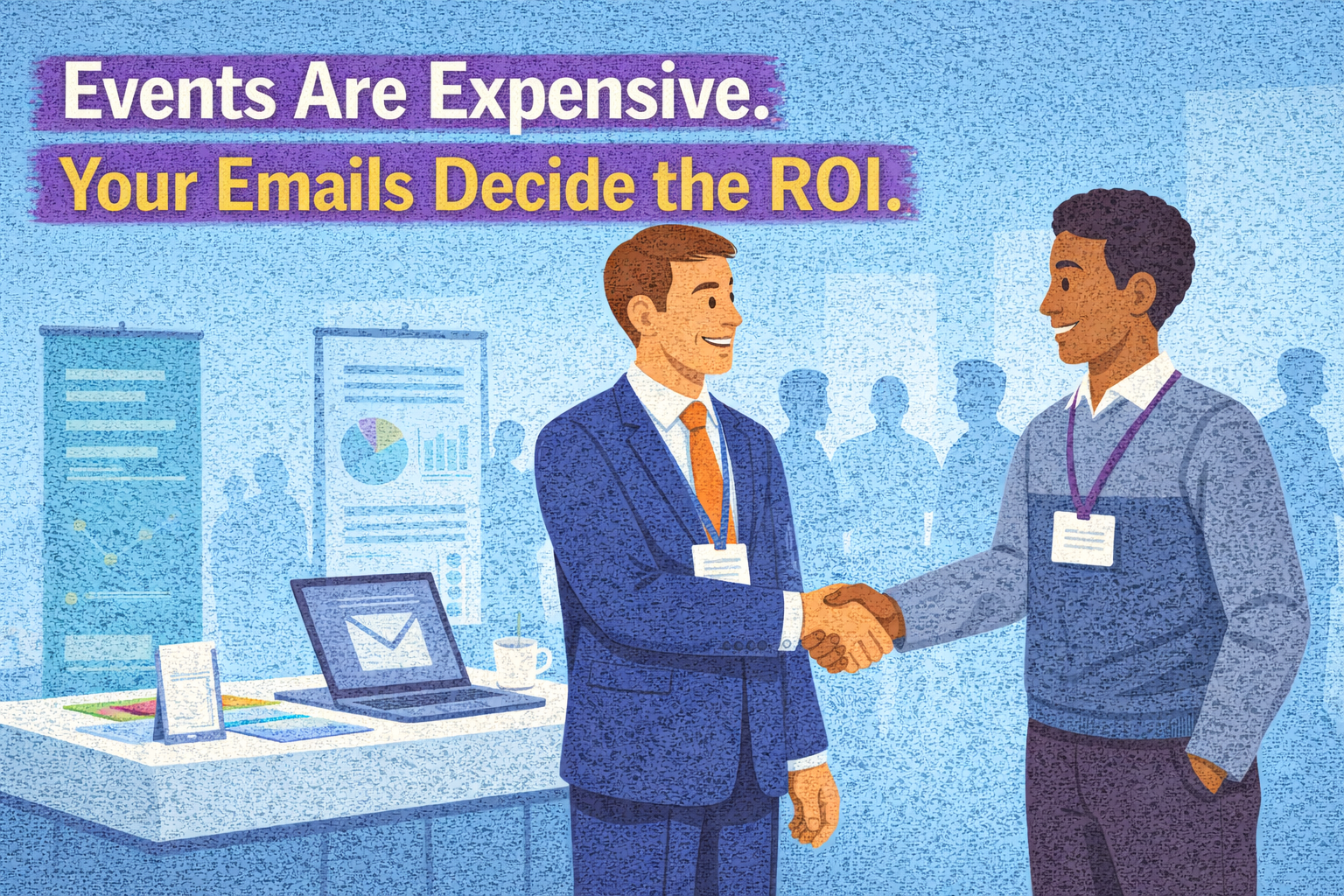
Companies spend a lot of money on conferences, dinners, webinars, etc. Just looking at conferences, between tickets, sponsorships, flights, hotels, dinners, side events, and swag.. You could be out millions. If you’re a public company, events show up as a (very) real line item on your P&L.
And yet, most teams dramatically underperform on the one thing that actually determines whether events pay off - Email.
The ROI of an event isn’t decided at the booth. It’s decided in the emails you send before and after it.
The Real ROI of Events Happens Outside the Event
Most teams treat events like a moment in time.
They focus on:
- Booth traffic
- Badge scans
- How many meetings happened on-site
But, that’s not where outcomes come from. Plenty of meetings never happen because you never reached out ahead of time. Plenty of connections are squandered because the follow up falls short.
Event ROI is driven by:
- The conversations you start before the event
- The conversations you continue after the event
And both of those live in email.
The Two Emails That Matter Most
There are only two types of sales emails that matter for events:
- Event invites (to conferences, to hosted events, etc)
- Event follow-ups
Most teams get both wrong.
Why Most Event Invites Fail
Whether you’re inviting someone to meet up at a conference, inviting them to a dinner, or you’re looking to get folks to a webinar, most organizations get a very simple thing wrong.
Event invites are written by marketing. This isn’t to say marketing is awful at writing. It’s to say the concept of writing a one to many invitation is flawed.
You’re left with a message that reads like a classic sales email with zero personalization. They’re long. They’re promotional. They’re filled with adjectives.
Words like:
- Exclusive
- Epic
- Unforgettable
They read more like an ad more than a note from a human.This is the core problem. Sales emails are one-to-one conversations. Event invites are usually written like one-to-many blasts.
Normal people would never talk like the emails you see go out.
The Core Mistake: Selling the Event
One of the biggest issues in cold outreach about an event is that the email tries to “sell the event” as if the event is the product.
The event is not the product. The event is just a part of the reason to reach out. But, like a supporting actor it’s not *the* reason for reaching out. You don’t meet at an event just to meet. You meet with a purpose. The event is just a means of making it happen.
A webinar might be interesting on it’s face, but that’s marketing’s job to sell. Your job is to apply that product to their needs.
That could be networking with other leaders at a dinner. It could be to discuss a core problem their business is facing.
When you try to sell the event itself, it becomes very clear that you’re only seeking a transaction.
People don’t ignore event invites because they hate events. They ignore them because the email doesn’t sound like it was written to them.
How to Write Event Invites Like a Normal Person
The mindset shift is simple.
Stop trying to sell the event. Start trying to start a conversation framed around why the event matters to them.
The best event invites:
- Are short
- Sound casual
- Feel like something you’d text a colleague
- Are framed on why it matters to them
If it’s an event you’re hosting, don’t oversell. They don’t explain the full agenda. They don’t try to create FOMO. Anchor on the context you have on them.
Rewriting the Invite
Most bad invites fail because they try to do too much. Either flowery language, or include an overly explanatory and descriptive overview.
The fix is subtraction.
A strong event invite usually includes:
- Where you’ll be
- Who else is going
- Why the recipient might care
That’s it. Need an example?
Hey Will, we’re hosting a dinner for founders in Atlanta on the 6th. Are you in town?
Some other founders in a similar stage will be there. We’re going to meet up at The Optimist to chat early stages.
Thought folks would appreciate your perspectives on PLG and brand building.
No emojis.
No marketing language.
It reads like a text.
Sneaking Event Invites Into Existing Conversations
One of the easiest ways to make event invites work is to stop treating them as standalone emails.
Instead, use them as follow-ups or as a PS.
If you’ve already sent a personalized email to someone, adding a short PS about an upcoming event feels natural.
The PS Invite
A simple PS can outperform an entire invite campaign.
Something like:
“PS, if you’re going to Dreamforce, we’ll be around Tuesday night.”
That’s it.
It works because it’s low-pressure.
Flipping the Script
Sometimes it also makes sense to do the opposite. Send a direct invite first. Then use a PS to reference prior context.
Hey Will, are you going to be at Southbound in Atlanta? Thought I might catch you for a coffee before.
PS. Saw the hiring. Hoping thats a sign the funding came through that was holding up convos when we spoke in August.
This works when:
- You’ve had past conversations
- You want to reopen a thread
- The event gives you a clean reason to reach out
A Simple Coordination Tip That Gets Overlooked
Email breaks down at events.
People are moving.
Notifications get missed.
Inbox zero is not happening.
If you’re actually planning to meet someone, exchange phone numbers ahead of time.
Text works better for:
- Last-minute coordination
- Quick updates
- Finding each other on-site
Conversational email makes this transition easy.
The Biggest Miss: Event Follow-Up
Most teams completely waste event follow-up.
They dump every attendee into an automated campaign.
They send marketing emails from a sales rep’s inbox.
They treat everyone the same.
This kills momentum.
Who Actually Deserves 1:1 Follow-Up
Not every attendee deserves a personal follow-up.
But anyone you had a real conversation with does.
That list should be intentional:
- People you met
- People you almost met but couldn’t nail coordinating
- People you knew were there that you missed, but are a high priority to reach
This is where segmentation matters.
Segmenting Event Attendees the Right Way
After the event, you need to segment attendees by:
- Those you met
- People who previously engaged the company
- Role, Industry, Geography
- Tools Used
- Signals like what’s happening at the company / industry
- Tier (or priority) of the account they work at
This sets you up to better tailor your message (automated or manually sent) to the prospect.
The event itself is not enough context.
You’re looking for a problem to hinge outreach on, not just proof you attended the same conference.
That can come from an observation, the experience of a customer that looks similar to them, or even a challenge that would be relatable given their segmentation, or the content of the event that they engaged with.
The event is not an excuse to talk about the product.
Writing Event Follow-Up Emails That Get Replies
The principle is simple.
Problems create priorities.
Your follow-up email should not recap the event.
It should reference a problem that came up because of the event.
Didn’t Catch them? Use the “Missed Connection Follow-Up”
“Sorry we missed each other” emails can work if they’re done right.
They should:
- Acknowledge the miss
- Reference conversations you had with peers
- Highlight a shared challenge
- End with curiosity
Example:
George, missed you at Inbound.
Talked to quite a few RevOps leaders playing w AI. Lot of folks seeing gaps where these tools don’t get smarter. They’re limited by what you put in.
We solve that. But, didn’t know if you were seeing similar. Did you end up making it to the event?
Curious if you saw the same.
The event is supporting context, not the point.
Didn’t get a chance to “sell”? Use this Light Post-Conversation Follow-Up
If you spoke briefly, but didn’t go deep in the conversation:
- Acknowledge the interaction
- Ask one focused question
- Keep it simple
Example:
George, so great catching up at Inbound. We didn’t get to go deeper but wanted to ask you about pipe gen.
Seeing a lot of folks feeling capped out. We’re helping teams max out email by understanding why email works. Coach real time to it.
If that sounded familiar, let’s catch up soon.
You’re continuing a conversation, not restarting it.
You can also make the Post-Conversation Follow Up Ultra Simple
Sometimes the best follow-up is one sentence.
George - Meant to ask you at Inbound. Is your team invested in any interesting AI tools?
One question.
No pitch.
The goal is to keep momentum alive.
The One Thing Not to Do After You Get a Reply
Don’t turn the reply into a pitch.
This is where most reps lose people.
If someone replies, your job is to stay human, not switch into demo mode.
Ask questions.
Respond like a person.
Keep the conversation going.
Events Are Human Moments
Events are about people, not booths.
The emails you send before and after determine whether the event was worth the investment.
Write invites that sound human.
Write follow-ups that reference real problems.
And remember, the event itself is just context.