
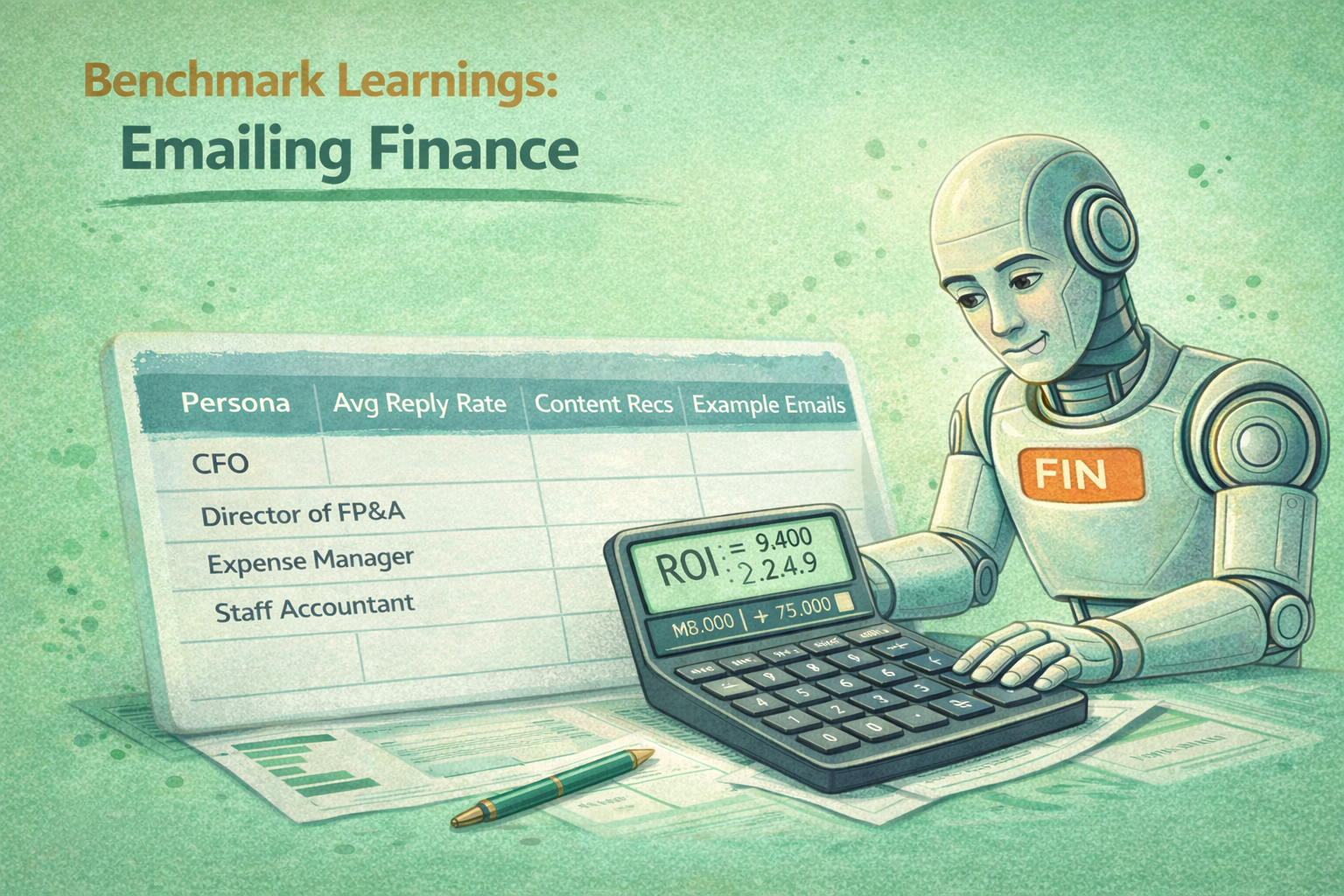
Benchmark Learnings: Emailing Finance
How to Cold Email Finance Leaders (And What 231,818+ Emails Say You're Getting Wrong)
Out of 231,818 cold emails in our latest Cold Email Benchmark Report, finance is one of the hardest departments to get a reply from. The reply rate? 3.2%.
That ties with marketing for the lowest reply rate across all departments. But the real story isn't the reply rate. It's the opportunity hiding behind it.
Only 6.1% of emails to finance earned a Lavender “A” grade. That's the lowest of any department in the dataset. For context, sales gets 18.3%. Marketing gets 14.3%. Finance gets 6.1%. Almost nobody is writing good emails to this group!
When sellers do write A-level emails to finance, the reply rate jumps to 5.7%. A 79% lift. That's not just the biggest lift in the dataset. It nearly doubles the reply rate!
To put it plainly: finance is the department where writing quality matters most, and where the fewest sellers are doing it well.
So what's going wrong? And how do you fix it?
Let's use some real examples as if we're a seller at Navan, a travel and expense management platform that helps finance teams get visibility and control over company spend. In the examples, we'll focus on use cases around T&E spend management and expense automation.
Finance isn't ignoring your email. They're ignoring your fluff.
The biggest pattern in the data is this: finance buyers respond to numbers, precision, and clarity. They punish anything that feels vague, hyped, or abstract.
This makes sense when you think about how finance leaders operate. Their job is risk assessment, cost control, forecasting, and compliance. They live in spreadsheets. They think in terms of time saved, dollars reduced, time to ROI, and risk mitigated. When you land in their inbox with fluffy language about "transforming their workflows" or "unlocking efficiency," you've already lost.
Here's a summary from what the data shows is working and not working when emailing finance:
What works: Outcome and numbers framing (time to ROI, costs, etc). Risk reduction and compliance are relevant. Direct, concise writing is crucial. Low-friction asks (don’t use open ended questions).
What doesn't: Fluffy or abstract language. Too many claims in one email. Long intros. Aggressive selling.
But what you say and how you say it shifts depending on who in finance you're emailing. A CFO and an AP coordinator think about their work very differently. So let's break it down by seniority.
Selling to Finance Executives (CFO, VP of Finance, Head of Finance)
Titles you're targeting: CFO, VP of Finance, VP of FP&A, Head of Finance, Controller, Chief Accounting Officer, Head of Treasury
What the data says about executives: C-Suite buyers reply at 4.8%, VPs at 3.4%, and Heads at 4.4%. Heads see a 42% lift on A emails, the highest across the executive tier. This is likely because Heads tend to operate in smaller organizations or sit in a more execution-oriented seat inside larger ones. They're less likely to be thinking "should I delegate this to…"
What this means for finance execs specifically: Finance executives care about cost, risk, and time as they relate to organizational strategy. Every email gets filtered through that lens. But they want those outcomes framed with precision, not hype. A marketing exec might engage with "44% lift in conversion." A finance exec wants to know: what did it cost, how long did it take, and what's the risk of doing nothing? Helping them see how it compares to other investments across the organization helps make this concrete for them.
The tone needs to be measured and direct. No superlatives. No exclamation points. No 'game-changing' anything. Finance execs think in numbers. So your email should too. Lead with a specific metric tied to a specific outcome. “Cut reconciliation time by 80%' registers” is much more precise than “Improve your financial operations”.
What to do
Lead with a company-level observation tied to a financial trigger: a fundraise, headcount growth, office expansion, a compliance deadline. Connect it to a cost or efficiency problem that surfaces at their stage. Back it up with specific numbers from a relevant customer. Frame the CTA as collaborative. Give them a path to delegate to someone on their team running the day-to-day.
What not to do
Don't lead with product features. Don't use abstract language. Don't hype your numbers without context. Don't stack multiple claims in one email. Finance execs are trained to be skeptical of numbers that sound too good. One clear, contextualized proof point beats three impressive-sounding stats. Also, save the technical details for a lower seniority.
Example: You're an AE at Navan, emailing a CFO
You noticed their company just raised a Series C and is scaling headcount across 3 offices.
David,
Series C + 3 offices. Team needs to be focused on staying aligned w/ raise goals.
But, T&E spend is about to get a lot harder to track (if it hasn't already)
Policy gaps between offices, new expenses… I’d bet your team’s spending 5-10 more hours a month reconciling.
Reduced similar stage company's T&E processing by 80%.
Want to see how they got time back to focus on staying aligned w/ raise goals?
Will
PS. If someone on your team is closer to the day-to-day on this, happy to connect w/ them directly.
Why it works:
The Opener: Two verifiable signals (fundraise + multi-office) combined into a single financial implication - less bandwidth for team. The parenthetical adds warmth without softening the directness.
The Problem: Quantified (5-10 hours/month) and specific (policy gaps surfacing). Both problems are framed as natural byproducts of growth, not accusations.
The Solution: Concrete and numbers-first. 80% reduction in processing time + real-time policy violation detection. No buzzwords. The proof point is framed as "a similar stage" which makes it feel relevant, not like a generic logo drop.
The CTA: Two paths. Engage directly or delegate to whoever owns expense management. This respects the CFO's time and shows you understand that a CFO probably isn't the one reconciling reports. The CTA also reinforces the higher level strategic issues tied to having the team bogged down in T&E reconciliation.
Tone: Measured. No hype. The numbers do the talking.
Note: The message doesn’t focus on the ins and outs of improving T&E workflow, it connects the dots back to the bigger strategic initiative for a finance leader. It focuses on ensuring the entire team is focused on staying aligned with the goals of the raise > the drudgery of expanding T&E requirements.
Selling to Finance Directors and Senior Leaders
Titles you're targeting: Director of Finance, Director of FP&A, Director of Accounting, Senior Finance Manager, Director of Treasury, Director of Financial Operations, Senior Controller
What the data says about this tier: Directors reply at 3.4% overall. Senior-level buyers jump to 8.4% on A emails, the biggest absolute lift in the entire seniority dataset. Given the jump we see in response rates for the finance persona, this only magnifies the importance of nailing outreach to this level.
This group is underserved by good outbound. That's your opportunity.
What this means for finance directors specifically: Directors and senior leaders in finance own specific functions: accounts payable, FP&A, financial reporting, treasury, compliance. They're not setting the company's financial strategy. They're directing the execution of it. A broad pitch about "financial transformation" doesn't map to anything they're responsible for.
What works is the opposite: show you understand the specific process their team manages and where it's breaking down. If you can name the exact reconciliation, report, or workflow that's eating their time, you're ahead of 93.9% of the emails landing in their inbox.
What to do
Anchor on a specific function they own. If you're emailing a Director of FP&A, talk about forecasting accuracy or budget variance. If it's a Director of Finance Operations, talk about close processes or expense reconciliation. Connect your observation to a visible signal (growth stage, new offices, recent hires). Keep proof to one relevant example with concrete numbers. Frame the CTA around gaining perspective.
What not to do
Don't pitch broadly. Don't use multiple value props. Don't write long intros. Don't use fluffy language. And especially for finance directors: don't name-drop without context. Saying "companies like Stripe use us" means nothing if you don't explain which problem Stripe had and how it maps to theirs. Finance people need the logic chain, not the logo.
Example: You're an SDR at Navan, emailing a Director of FP&A
You noticed their company tripled headcount in the past year and recently opened a second office in a different state.
Rebecca,
3x the headcount + a new office. How's the team thinking about forecasting for expenses?
Usually see old assumptions break down when thinking about things like offsites, in person meetings, sales travel, etc.
If we could offer better analytics on travel spend, am I off in thinking you could stay ahead of potential spend outliers.
Why it works:
The Opener: Two visible growth signals combined into a direct question about how it's affecting their work. The question is genuine. It invites them to share context.
The Problem: Specific to the FP&A, they need to have accurate forecasts. So showing you understand old model assumptions break down creates credibility. This wouldn't resonate with a CFO. But it speaks directly to what a Director of FP&A deals with weekly.
The Solution & CTA: Positioned as a conditional ("If X, am I off to think Y) avoids feeling like a pitch. This lets them self-qualify. The concept is specific - better analytics = better forecasts.
Tone: Direct, measured, no hype.
Selling to Finance Managers
Titles you're targeting: Finance Manager, Accounting Manager, AP Manager, AR Manager, FP&A Manager, Payroll Manager, Expense Manager, Tax Manager
What the data says about managers: Managers reply at 4.3% overall, with A emails climbing to 6.3%. A 49% lift. Nearly half as many replies added just from writing a better email.
What this means for finance managers specifically: Finance managers run the processes. They're the ones closing the books, managing the AP queue, reconciling expenses, and building the reports their directors review. They care about one thing: does this make the thing I do every week faster, easier, or more accurate?
Abstract strategy doesn't register. Neither does ROI framing at the company level. They want to know: will this save me time on Wednesday?
The tone for finance managers is the trickiest in this department. Finance as a whole wants precision and directness. But managers also respond to a friendly, professional tone. You can't be as warm as you'd be with HR. But you can't be as cold as a spreadsheet either. Think: a peer at a similar company who found a better way to do the same job.
What to do
Focus on a specific process they own and show you understand the friction. Be clear about what you solve and quantify the outcome. Structure the email so it's easy to scan on mobile. We see an email's first impression is 8x more likely to happen on mobile, so short paragraphs matter here. Keep the CTA specific and tied to a workflow improvement.
What not to do
Don't talk about company-wide financial strategy. Don't use abstract language. Don't write walls of text. And for finance managers in particular: don't try to impress with jargon. "CLO tranches" and "upside and downside capture" without context for why it matters to them is a fast way to get deleted. Speak plainly about the process, not the terminology.
Example: You're an SDR at Navan, emailing an Expense Manager
You noticed their company has grown to 400+ employees across multiple departments and the careers page shows they're hiring more sales reps (who presumably travel).
Kevin,
Imagine works been busier than ever with the growing sales org. (crossing 400+ employees)
Are you finding your team chasing down sellers at month’s end to keep the ops and the FP&A team off your backs?
We’re automating receipts, out of policy expenses, etc. Want to see how we got a team like yours from 8 hrs/week reconciling to just 2?
Why it works:
The Opener: Calling out their work as being busier than ever in relation to the team’s growth is both warm and friendly while calling out that you did your homework.
The Problem: The issue of chasing sellers down is relatable language they likely use. Doubling it with a clear understanding of how their internal teams interact boosts relatability and credibility as well.
The Solution: Specific work tied back the problem asked about creates a clear view of where Navan can help.
CTA: The ask isn’t to just have a call, its to see how something that takes 8 hours can be reduced to under 2. Realistic, specific, and directly tied to the workflow described. Easy to say yes or no.
Formatting: Short paragraphs, scannable on mobile. The progression from observation to problem to solution to proof is clean and fast.
Selling to Individual Contributors in Finance
Titles you're targeting: Financial Analyst, Staff Accountant, AP Specialist, AR Specialist, Bookkeeper, Payroll Specialist, Expense Analyst, Junior FP&A Analyst, Billing Coordinator
What the data says about ICs: Individual contributors reply at 5.3%, higher than directors, VPs, and managers. A-level emails push that to 8.0%, a 49% lift. ICs are one of the most responsive groups in the dataset.
What this means for finance ICs specifically: Finance ICs care about the task in front of them. Not the company's financial strategy, not the department's goals. The reconciliation they're running. The report they're building. The expense submissions they're processing. If you can name the specific thing that's eating their afternoon and show them a way out, they'll reply.
The tone should be the most approachable across the finance seniority ladder. Finance as a department skews formal, but ICs are more receptive to a friendly, direct message. Keep it simple. Keep it short. Don't try to sound like a finance expert. Just sound like someone who understands the tedious parts of their job.
Important caveat: finance ICs rarely have buying authority. Your goal is to start a conversation that either surfaces useful information about their current process or gets you introduced to whoever owns the budget.
What to do
Keep it short. Really short. Name the specific task or process they're spending time on. Frame the benefit as time saved on a specific activity. Keep the CTA small and discovery-focused.
What not to do
Don't talk about ROI, strategic priorities, or cost optimization at the org level. Don't write long emails. Don't use finance jargon they might not even use themselves (plenty of AP specialists don't think in "T&E optimization" terms). And don't assume they care about your product. They care about getting their work done faster.
Example: You're an SDR at Navan, emailing a Staff Accountant
You noticed their company recently went through a large sales hiring wave based on LinkedIn activity.
Taylor,
With all the new sellers, am I crazy to think it's gonna take a minute to get new expense data together? (see a lot of sellers take a minute to get used to new expense processes)
Instead of chasing data when you go to close the books, we can pipe it directly into your ERP. Are y’all on Netscape or Quickbooks?
Why it works:
Length: 57 words.
Tone: The informal “am I crazy to think?” and (see a lot of sellers take a minute) in parentheses taps into how you’d communicate with a coworker.
Personalization: The new sellers are tagged right out of the gate.
Problem & Solution: Very workflow oriented (closing books at month’s end done faster with data integrations)
The CTA: It’s a simple question, do you use X or Y? If they don’t use either? The fastest way to get an answer online is to provide the wrong one. ;)
The throughline
Finance is the department with the biggest gap between bad outreach and good outreach. The 79% lift on A emails isn't just the highest in the dataset. It tells you something specific: finance buyers want to respond to good emails. They're just not getting them.
93.9% of emails to finance don't earn an A grade. That's the worst quality rate of any department. And it's not because finance is complicated. It's because sellers keep making the same mistakes: abstract language, hype without proof, multiple claims crammed into one email, and a tone that reads like marketing copy instead of something a finance person would take seriously.
But what changes across the seniority ladder is the scope of what you're solving.
For a CFO, it's about a company-level cost or risk problem tied to a growth event.
For a director, it's about the specific function they own. The reconciliation. The reporting. The compliance workflow.
For a manager, it's about making a specific weekly process faster and more accurate.
For an IC, it's about the task that's eating their Thursday afternoon.
The tone stays precise throughout. No fluff at any level. But the altitude shifts. And the numbers need to be real, contextualized, and tied to a problem they recognize.
That's how you earn a reply from someone who evaluates everything in terms of cost, risk, and time.
If you want to see the full benchmarking data across all departments, seniority levels, and industries, the Cold Email Benchmark Report is live.
And if you want to write emails like these, with real-time coaching adapted to your buyer, see what Lavender can do for you.