
Benchmark Learnings: Emailing Operations
How to Cold Email Operations Leaders (And What 231,818+ Emails Say You're Getting Wrong)
Out of 231,818 cold emails in our latest Cold Email Benchmark Report, operations is one of the most important departments sellers prospect into. It's also one of the least rewarded. The reply rate? 3.4%.
That puts operations near the bottom across departments. And there's a reason: ops leaders are the busiest people in any company. They're running the processes that keep everything moving. So unless your email connects to a process they already know is broken, it's noise.
But here's what the data reveals: only 13.1% of emails to operations earned a Lavender A grade. That means roughly 7 out of 8 emails in ops inboxes have clear, fixable problems that would improve their reply rates.
When sellers write A-level emails to operations, the reply rate climbs to 5.4%. A 58% lift. That's one of the larger quality lifts across all departments. Ops leaders do reply to cold email. They just need to be able to quickly understand the very specific reason that they should.
So what actually works? And why does most outbound to ops fall flat?
Let's use some real examples as if we're a seller at Scribe, a tool that auto-generates step-by-step process documentation as people work. In the examples, we'll focus on use cases around process documentation and onboarding, which are the pain points ops teams feel most acutely during growth.
Operations isn't ignoring your email. They're ignoring vague use cases.
The biggest pattern in the data is this: ops buyers respond to emails that name a specific process. Not a category. Not a "workflow challenge." A process. The actual thing they're spending time on.
"Are you still managing documents manually?" is a real question asked to an ops leader from the dataset. It didn't work. It's too broad. What documents? For whom? In what workflow? An ops leader reads that and thinks: this person doesn't know what I do.
This is where personalization (real, relevant personalization) kicks in!
You see, what works is the opposite: efficiency framing tied to a concrete workflow. Show that you understand which process is likely broken, why it's broken at their stage, and what fixing it actually looks like in terms of time, steps, or headcount.
That’s not personalization in the personal sense. It’s personalization in the 1:1, I understand your work based on your specific background and situation sense.
Here's a summary from what the data shows is working and not working when emailing operations:
What works: Efficiency framing with concrete workflows. Short, direct emails with clear outcomes. Credibility signals work. A straightforward CTA with a clear next step.
What doesn't: Abstract strategy without process anchors. Dense paragraphs. Multiple value props. Overly salesy tone. Presumptive language about problems they may not have.
That last point is specific to ops and worth highlighting. The data flagged emails that open with assumptions like "Most IT teams at your size are stretched thin" or "Managing unpredictable lobby traffic is likely a growing operational challenge." Ops leaders read those and think: you're guessing. And they're right.
The fix: ask instead of assume. Turn your hypothesis into a question. It's the same observation, but it invites a conversation instead of projecting a problem.
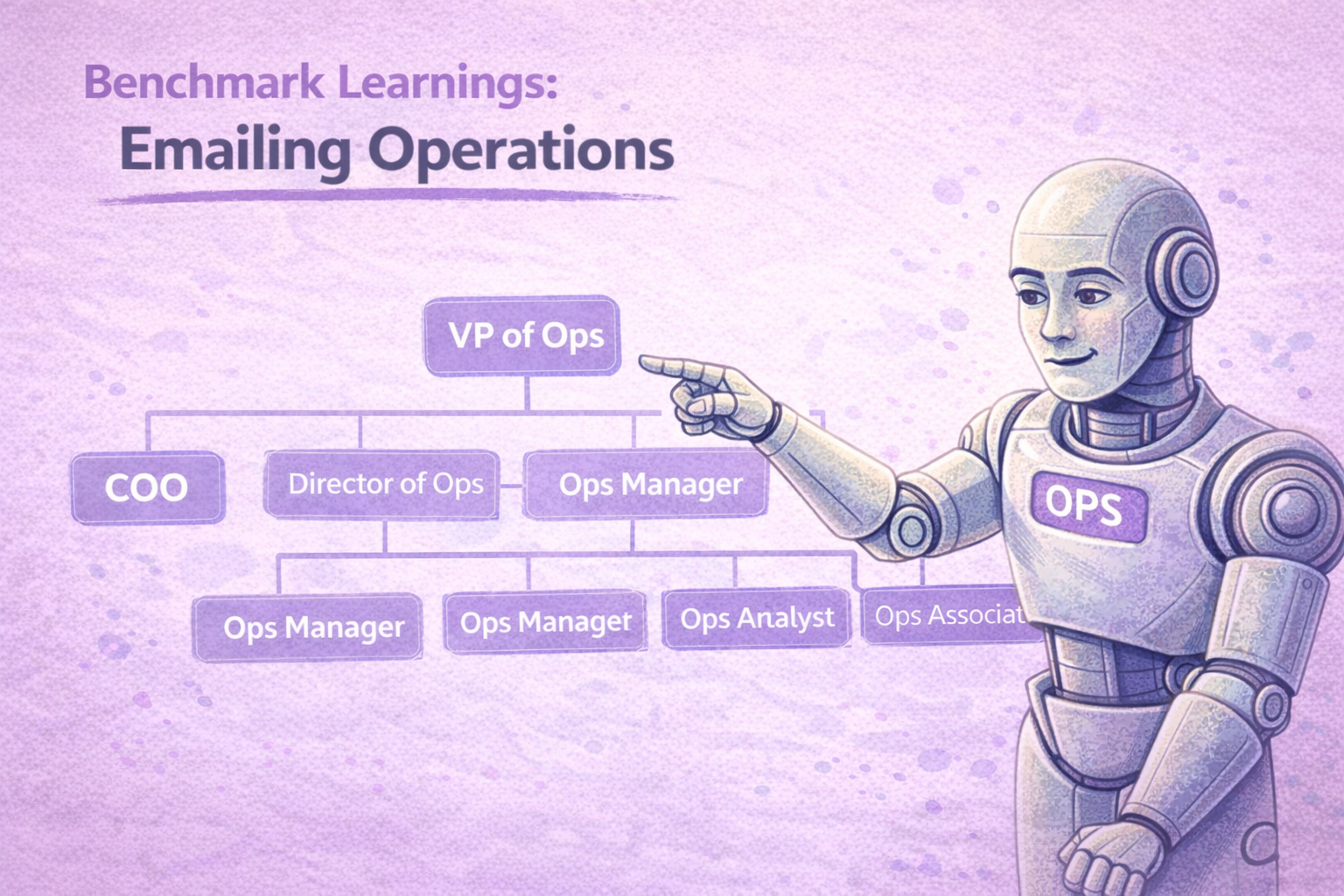
But what you say and how you frame it shifts depending on seniority. A COO and a process coordinator think about operations at very different altitudes. So let's break it down.
Selling to Operations Executives (COO, VP of Ops, Head of Operations)
Titles you're targeting: COO, VP of Operations, VP of Business Operations, VP of Revenue Operations, Head of Operations, Head of Business Ops, VP of Customer Operations
What the data says about executives: C-Suite buyers reply at 4.8%, VPs at 3.4%, and Heads at 4.4%. Heads see a 42% lift on A emails, the highest across the executive tier. This is likely because Heads tend to operate in smaller organizations or sit in a more execution-oriented seat inside larger ones. They're less likely to be thinking "should I delegate this to..."
What this means for ops execs specifically: Operations executives think in systems. Their job is making sure the org scales without things breaking. Every email gets filtered through: does this help us do more without adding headcount proportionally? Does this reduce the operational risk of growing fast?
The tone should be direct and efficient. Ops execs respect brevity because they practice it. Don't waste time building rapport before the point. Lead with the point.
What to do
Lead with a company-level observation tied to a scaling signal: headcount growth, new products, new offices, new customer segments. Connect it to an operational bottleneck that surfaces at that stage. Back it up with a concrete outcome from a relevant company. Frame the CTA as collaborative. Give them a path to delegate to whoever is closer to the specific process.
What not to do
Don't lead with product features. Don't use abstract strategy language ("optimize your operational efficiency"). Don't make multiple asks. Don't write more than 100 words. And don't assume you know their problems. Ask. Ops execs have seen too many sellers guess wrong. Save the process-level details for a lower seniority.
Example: You're an AE at Scribe, emailing a VP of Operations
You noticed their company tripled their product catalog in the past year and is hiring customer success managers across multiple time zones.
Dana,
3x the product catalog in a year while onboarding CS reps across time zones. Curious if ops is on point to keep things straight.
Our product auto-generates process docs as your team works. No one stops to write anything. One ops team cut their documentation time from 2 weeks to 2 hours.
Think it could help get these new hires (and existing CS reps) keep things straight?
PS. If someone on your team is closer to the onboarding workflows, happy to connect w/ them directly.
Why it works:
The Opener: Two verifiable signals (product catalog growth + multi-timezone hiring) combined into a single operational implication mentioned in a nonassumptive way. By saying “curious if ops is on point” it seeks to verify if they have a KPI their being held against. This hits are the right altitude for a VP.
The Problem: The problem is obvious based on the first paragraph, getting more detailed about obvious things will not help with a persona adverse to messaging that comes across as “ops leaders like you”. Instead, the pain is reemphasized in the CTA.
The Solution: Two sentences. What Scribe does and why it matters. No feature list. The proof is specific (2 weeks to 2 hours) and tied directly to the documentation bottleneck described.
The CTA: Two paths. Engage directly if relevant or delegate. "Someone on your team closer to the onboarding workflows" shows you understand that a VP isn't writing the docs.
Tone: 86 words. Direct. Informal phrasing like ops, on point, keeping it straight and parentheses keep it conversational. The message isn’t assumptive, instead it says if this is a focus, we can help, but let me know if I’m wrong.
Selling to Operations Directors and Senior Leaders
Titles you're targeting: Director of Operations, Director of Business Operations, Director of Revenue Operations, Director of Customer Operations, Senior Operations Manager, Director of Process Improvement
What the data says about this tier: Directors reply at 3.4% overall. Senior-level buyers jump to 8.4% on A emails, the biggest absolute lift in the entire seniority dataset.
This group is underserved by good outbound. That's your opportunity.
What this means for ops directors specifically: Directors in operations own specific operational domains: customer onboarding, internal processes, rev ops infrastructure, cross-functional workflows. They're not setting company strategy. They're making sure the machine runs. Broad pitches about "operational transformation" don't map to anything they're accountable for.
What works: name the specific process domain they own. Show you understand where it's straining. The data calls this out clearly: this group responds to relevance to functional priorities and specific use cases. Generic templates and salesy language are what kill engagement.
What to do
Get specific about the operational domain they own. If you're emailing a Director of Customer Operations, talk about onboarding workflows and handoff processes. If it's a Director of Rev Ops, talk about data hygiene or process standardization across the GTM team. Anchor your observation in a visible signal. Keep proof to one relevant example. Frame the CTA around comparing approaches.
What not to do
Don't pitch broad. Don't use multiple value props in one email. Don't write long intros. And don't be presumptive about their problems. The data specifically flagged this as a failure pattern for ops. "Managing unpredictable lobby traffic is likely a growing challenge" doesn't work. "How are you handling X as you scale?" does.
Example: You're an SDR at Scribe, emailing a Director of Customer Operations
You noticed their company recently launched a self-serve product tier alongside their existing enterprise offering, and they're hiring implementation specialists.
Marcus,
Self-serve + enterprise on the same product is two very different onboarding motions. Imagine as the team sees blockers for self service, you’re adapting the enterprise docs to speak to these self serve folks.
If you could auto-gen these docs as your team actually runs the processes (instead of carving out time to write them), would that help?
PS. Helped a team build docs for a new product in half the time. Let me know if it’s worth a walk through of how they did it.
Why it works:
The Opener: Naming both product tiers and framing it as an operational challenge (two onboarding motions) shows you understand the complexity.
The Problem: The explicit problem is implied by using a clear view of their situation, “as the team sees blockers for self service, you’re adapting the enterprise docs to speak to these self serve folks.” This line shows their time is being spent rebuilding process docs as issues come up.
The Solution: Positioned as a question ("would that help?") which lets them self-qualify. The parenthetical contrast (auto-generate vs. carving out time) frames the value without a feature dump.
Credibility: Looped into a PS, it shows the value of using the solution quickly. Not every customer story ties 1:1 to the recipients situation. But it can be easily extracted to understand that new products being documented in half the time could be directly applicable to their situation.
Selling to Operations Managers
Titles you're targeting: Operations Manager, Process Manager, Business Operations Manager, Customer Operations Manager, Implementation Manager, Enablement Manager, Onboarding Manager
What the data says about managers: Managers reply at 4.3% overall, with A emails climbing to 6.3%. A 49% lift. Nearly half as many replies added just from writing a better email.
What this means for ops managers specifically: Operations managers are the execution layer. They're the ones building the SOPs, running the onboarding sessions, managing the tools, and fixing the broken handoffs. They care about practical usefulness: does this make the process I run every week easier?
Abstract strategy doesn't land. Neither do vague promises about efficiency. The data is clear: managers respond to clear pain points and concise, structured emails. They disengage at dense paragraphs and salesy tones.
The tone should be direct and friendly. Ops managers deal with process all day. They appreciate someone who gets to the point. Remember that an email's first impression is 8x more likely to happen on mobile, so structure matters. Short paragraphs. Easy to scan.
What to do
Focus on a specific process they manage and show you understand where the friction is. Be direct about what you solve. Quantify the outcome. Structure the email for mobile. Keep the CTA specific and tied to a workflow they own.
What not to do
Don't talk about company strategy. Don't use multiple value props. Don't write walls of text. And don't use salesy language or vague CTAs. "Thoughts?" doesn't work with ops managers. They want to know exactly what you're proposing and exactly what they'd get from saying yes.
Example: You're an SDR at Scribe, emailing a HR Operations Manager
You noticed their company's Glassdoor reviews mention that onboarding is messy and that the environment is very “sink or swim” citing a lot of turnover in customer facing roles.
Jamie, one of your glassdoor reviews points to a “sink or swim” culture.
Know it can be a biased source. But, documentation of process could be an easy way to mitigate this if that review is actually a sign of turnover problems.
We can auto-capture folks' work across Slack, email, tools, etc. Turn it into playbooks. Get new hires feeling comfortable fast.
Want to see how we helped a startup get their documentation straight within a month from onboarding?
Why it works:
The Opener: Glassdoor reviews are a touchy signal. It points out a real problem, but by calling out that it can be biased, and using terms like “if that review is actually” shows you’re not pointing fingers.
The Solution: Gets specific on where the product can pull information automatically to solve for documentation. It gets specific, so they can see exactly where they could apply it to teams.
Credibility: Referencing other startups dealing with this, says “you’re not alone”. But, it also says we’ve done this before.
The CTA: An offer to see how another company is doing this is much more tactical than offering a demo or a vague question of if this is helpful.
Formatting: Short paragraphs, scannable on a phone without scrolling. Short sentence structures make it easy to breeze through the text.
Selling to Individual Contributors in Operations
Titles you're targeting: Operations Coordinator, Operations Analyst, Process Coordinator, Implementation Specialist, Onboarding Specialist, Operations Associate, Business Analyst, Revenue Operations Analyst
What the data says about ICs: Individual contributors reply at 5.3%, higher than directors, VPs, and managers. A-level emails push that to 8.0%, a 49% lift. ICs are one of the most responsive groups in the dataset.
What this means for ops ICs specifically: Ops ICs are the people doing the work. They're the ones running the processes, building the docs (when they have time), training new hires, and fielding the "where's the doc for this?" questions. They care about one thing: making the repetitive part of their job less repetitive.
The tone should be the most casual across the seniority ladder. Direct, friendly, short. No process improvement jargon. No "operational excellence." Just: here's something that might save you time.
Important caveat: ops ICs rarely have buying authority. But they're often the ones who surface tool recommendations to their manager. Your goal is to start a conversation, not close a deal.
What to do
Keep it short. Really short. Name the specific task they're probably spending time on. Frame the benefit as time saved on that task. Keep the CTA discovery-focused.
What not to do
Don't talk about ROI or organizational outcomes. Don't write long emails. Don't use formal language. And don't pitch. Ops ICs are the most likely to respond if the email feels like a helpful tip from a peer, not a sales sequence.
Example: You're an SDR at Scribe, emailing an Revenue Ops Specialist
You noticed their company recently launched a new product integration and is onboarding partners to it.
Taylor, you on point for building the new partner docs for the integration launch?
Asking bc they’ll ask questions your team hasn’t gotten yet. As y’all sort bringing these folks on, we can auto-document (pulling across Slack, Email, tools, etc) to get the right process locked in faster.
Why it works:
Length: 47 words. Casual and direct.
Personalization: Tied to a specific, visible initiative (new integration + partner onboarding) and connected to the IC's likely task (building the docs).
Tone: "you on point?" is an informal way to ask about their current process. "Asking bc" keeps it conversational.
Solution: Directly tied to the specific work that needs to be done, so they can see exactly how it might help them.
The CTA: You might think it is missing. Or you might think the CTA is the qualification question of if they’re the person on point. In reality, the CTA is implied. This nuance makes the message read less like a formal sales email and more like a text from a friend. If the work is relevant, its understood they’d respond. It also sets up the conversation for you to follow up and ask more specific questions tied to getting the assumptions about their work incorrect, so you could recraft the message to speak to other ways this new process could be creating new issues for this person in their role.
The throughline
Operations is a department that runs on processes. They respond to emails that name a specific one.
The pattern in the data is clear: abstract strategy language without process anchors doesn't work. "Optimize your operations" means nothing. "Auto-generate the onboarding docs your team doesn't have time to write" means everything.
But what changes across the seniority ladder is the scope of the process you're referencing.
For a COO, it's about a company-level scaling bottleneck. The system that's about to break.
For a director, it's about the specific operational domain they own. Customer onboarding. Internal enablement. Rev ops infrastructure.
For a manager, it's about the process they run every week and where the friction is.
For an IC, it's about the task they're doing by hand that could be automated.
The tone stays direct throughout. No fluff at any level. But the altitude shifts. And the proof needs to be tied to a real process with a real outcome. Ops buyers don't care about your platform. They care about whether their Wednesday gets easier.
86.9% of emails landing in operations inboxes don't earn an A grade. But the 58% lift on A emails tells you the opportunity is real. Name the process. Show that it's broken. Prove you can fix it.
That's how you earn a reply from someone who keeps the machine running.
If you want to see the full benchmarking data across all departments, seniority levels, and industries, the Cold Email Benchmark Report is live.
And if you want to write emails like these, with real-time coaching adapted to your buyer, see what Lavender can do for you.