
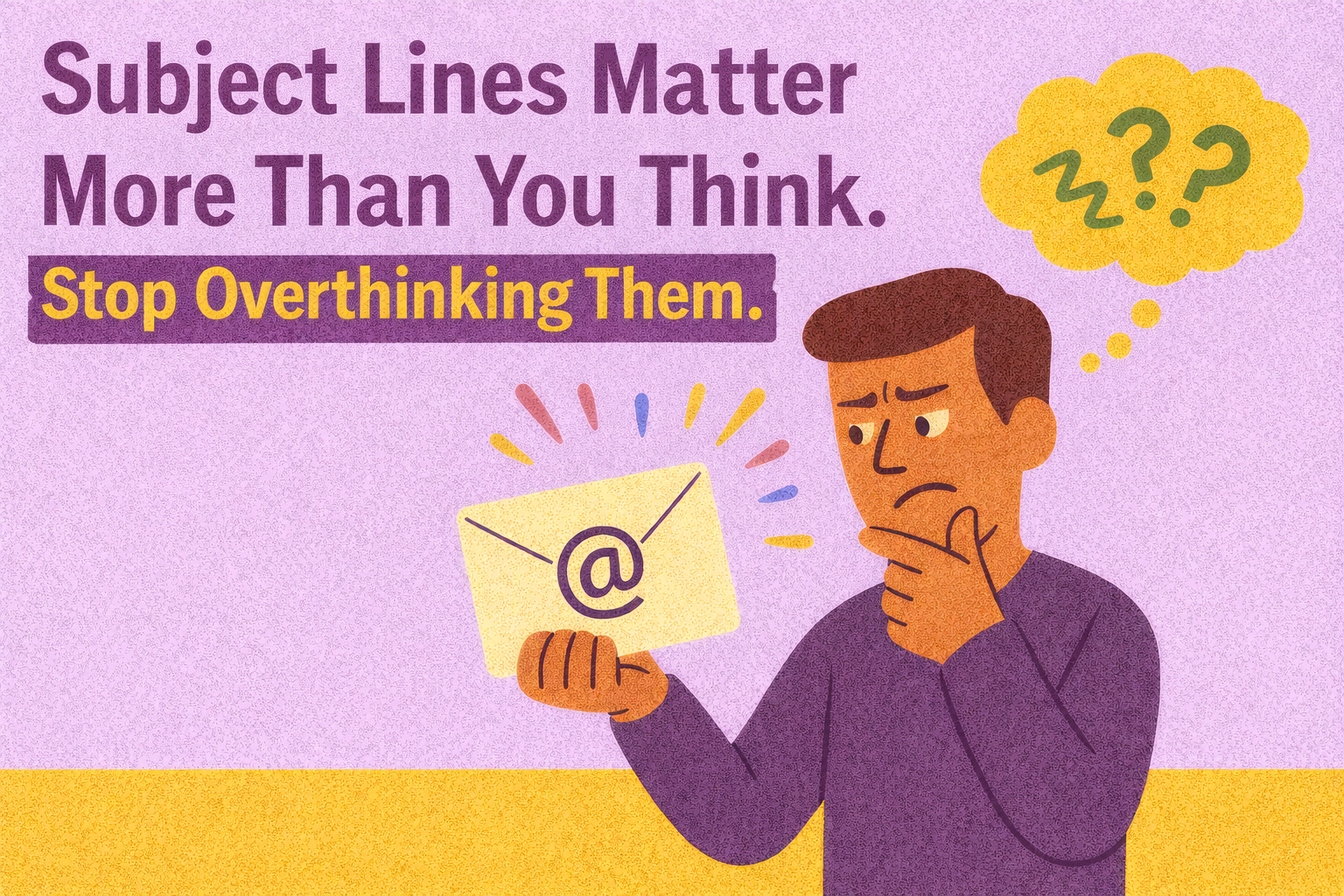
Subject Lines Matter More Than You Think: Stop Overthinking Them.
Why does a company like Netflix obsess over preview images?
Why do top YouTube creators spend hours on thumbnails?
It’s simple, you can’t get someone to watch until they click.
Email works the same way, with a twist.
You can’t get a reply until you get the open. But it also sets the reader’s context for what’s in the email. So while you might be overthinking your subject line, the right thinking can set your cold emails up for success. But, the wrong thinking could set you up for failure.
How People Actually Behave in Their Inbox
The reason subject lines matter comes back to how people behave in their inbox. People don’t read emails. They scan:
- Names
- Threads they recognize
- Subject lines
- Preview text, the first few words only
If they open it, they’re spending ~3 seconds deciding if they’ll delete it or not.
Everything revolves around categorizing the message. So the subject line plays a critical role in setting the stage for how they categorize the message.
And here’s the ironic part, while subject lines are important, most sellers overthink subject lines. As a result, they get it all wrong.
The Mental Spam Filter
Before we look at examples, you need to understand one thing.
Every reader has a mental spam filter.
Your subject line either:
- Feels internal and natural
- Or feels like a pitch and gets ignored
The goal is not to be clever. The goal is to blend in.
💡A Quick Subject Line Rule: The subject line must accurately cover the content of the email.
Pop Quiz! Can You Spot the Cold Email?
You only know one thing about an email, the subject line.
Which one is the cold email?
Option 1:
Will, struggling to get more replies
Option 2:
Template question
If it’s not obvious, option one is the cold email.
Let’s look at what’s inside that email.
Email Example 1: Personalized Cold Email
The Email:
Congrats on hiring, Joan. Coming off your time at Acme, I imagine you have a playbook for how they’ll ramp.
Usually our customers focus training on phones, but email results lag. Apex, now at +20% reply rates, struggled to coach here. Templates worked for some, but not others.
Our inbox coach helped them level up. Open to seeing how?
—
It’s a solid email. So the subject line needs to match what’s inside.
Subject Line Examples for Email 1
❌ Example 1: “Phone vs Email”
No. Not only is this not what the email is about, it risks sounding salesy. When would you ever say phone vs. email internally? It’s not natural.
❌ Example 2: “Templates working?”
Nope. The question mark immediately screams pitch.
✅ Example 3: “Template question”
Yes. This works because template analytics are actually discussed in the email. It “feels” like the type of email a seller might send to their manager.
❌ Example 4: “Level up reps”
No. Only a marketer would say this. The only way to make this worse would be to add a possessive. Even worse if it were “Level up your reps.”
✅ Example 5: “Acme playbook”
Yes! This leans into the personalization by referencing their prior experience, not their current role.
✅ Example 6: “Hiring playbook”
Yes. Similar effect to example 5. It feels relevant, internal, and descriptive.
Email Example 2: Double Personalization
The Email:
George, you’ve been on a hiring tear.
If my math is correct, you grew the team by 26%. Selling into a technical persona, I imagine email is key.
Would it help if you knew why some reps do well with email and others don’t?
—
This email layers:
- Hiring activity
- Who they sell to
That gives you more subject line options.
Subject Line Examples for Email 2
✅ Example 1: “Onboarding challenge”
Yes. This leans directly into personalization. But, there’s better options.
✅ Example 2: “Onboarding”
Yes, worth testing. It’s short, natural, and feels like something you’d send off the cuff internally.
❌ Example 3: “20% growth”
No. Metrics and percentages tend to hurt reply rate performance. When’s the last time you started an internal email with a statistic in the subject line? It’s unnatural.
✅ Example 4: “New hires”
Yes. Same personalization angle as onboarding from example 2.
🤷 Example 5: “Template question”
Maybe. Feels internal, but slightly deceptive given it’s not a question about templates. Worth testing, but borderline.
❌ Example 6: “Technical persona templates”
Nope. It’s not internal language. They likely don’t refer to their technical persona as “technical persona” that’s external language. Something like “technical templates” or “persona templates” or “CISO Templates” would be safer as it feels like something they’d send internally. But, the email doesn’t reference templates which disconnects the subject from the message.
Email Example 3: Less Personalization = More Risk
The Email:
When I talk to SDR leaders about email, they struggle with low reply rates and understanding why email works.
Apex used Lavender to pull out 50% plus reply rate plays from their email data.
This email is much closer to a traditional sales email, which makes subject lines harder.
—
Subject Line Examples for Email 3
❌ Example 1: “50% reply rate”
No. We covered that metrics don’t perform well in subject lines. We haven’t earned the right to talk about our successes yet.
❌ Example 2: “Email struggles”
No. Emotionally charged language hurts response rates. The subject is also too vague.
🤷 Example 3: “Apex’s reply rate”
Maybe. Who is Apex? You could get people curious. But, it sits in a gray area. Naming a competitor or a name in their space they’d recognize would be powerful here.
✅ Example 4: “Email data”
Yes. While it’s vague, it still feels like a throw away internal email and is accurately descriptive of the email.
🤷 Example 5: “Reply rate data”
Maybe. But, it’s very close to sounding like a report. This can lead readers to feel misled. Still usable, but risky.
✅ Example 6: “Email reporting”
Yes. The “ing” makes it clear this isn’t an official internal report, so you reduce your risk of them feeling misled.
The One Rule for Subject Lines
There is only one rule you must follow:
The subject line must describe what’s inside the email.
Nothing more. Nothing less.
The Internal Camouflage Framework
This is the framework we preach at Lavender. While some aspects might be pulled out, "playbooked", and turned into patterns, ultimately if you principle your email subject writing in this framework you’ll see lasting success.
The goal of internal camouflage is to get past the mental spam filter by making the email feel internal without being deceptive.
Rules of camouflage:
- Keep it short
- Keep it boring
- Keep it descriptive
- Make it feel internal
This framework is shaped by:
- The billions of emails we’ve analyzed
- Thousands of coaching sessions with teams
- The behavior of buyers in their inbox
Adapting Subject Lines for Less “Cold” Situations
Cold outreach is different from familiar moments.
If someone:
- Came inbound
- Booked a demo
- Is being re-engaged
Lean into familiarity.
People look for names and threads they recognize.
Example Subject Lines for Familiar Contexts
Instead of:
Template question
Try:
- Lavender new hires
- Lavender email report
- Lavender find time
- Lavender learn more
Adding your company name reduces friction and increases trust.
There is no "perfect" subject line
Your data will tell you what works. Test often. Pay attention. And remember:
If the subject line doesn’t match the email, the email never has a chance.