
The Complete Guide to Account-Based Prospecting
Buying software and services is no longer an individual decision. It’s a team sport, and that reality is exactly what makes deals harder to get done. Pair this with the reality that it’s never felt harder to get responses from the people who “make decisions”, and you start to see there’s value in a new approach to prospecting.
Account based marketing has been popularized for years. But, the concept never truly translated back to sales in a tactical way.
Teams still approached prospecting either too narrowly, or with a spray and pray mentality across the account. If your marketing efforts are generating interest within the account, that’s great. This guide is for the sellers who want to do more with these accounts and for the sellers who aren’t seeing the same support for their marketing departments.
In this guide, you’ll learn:
- Mapping the account
- Tactically how to work an account top to bottom
- How to prospect to the individual contributors “below the line” of decision making
- How to leverage introductions
- How to get the most unengaged execs involved.
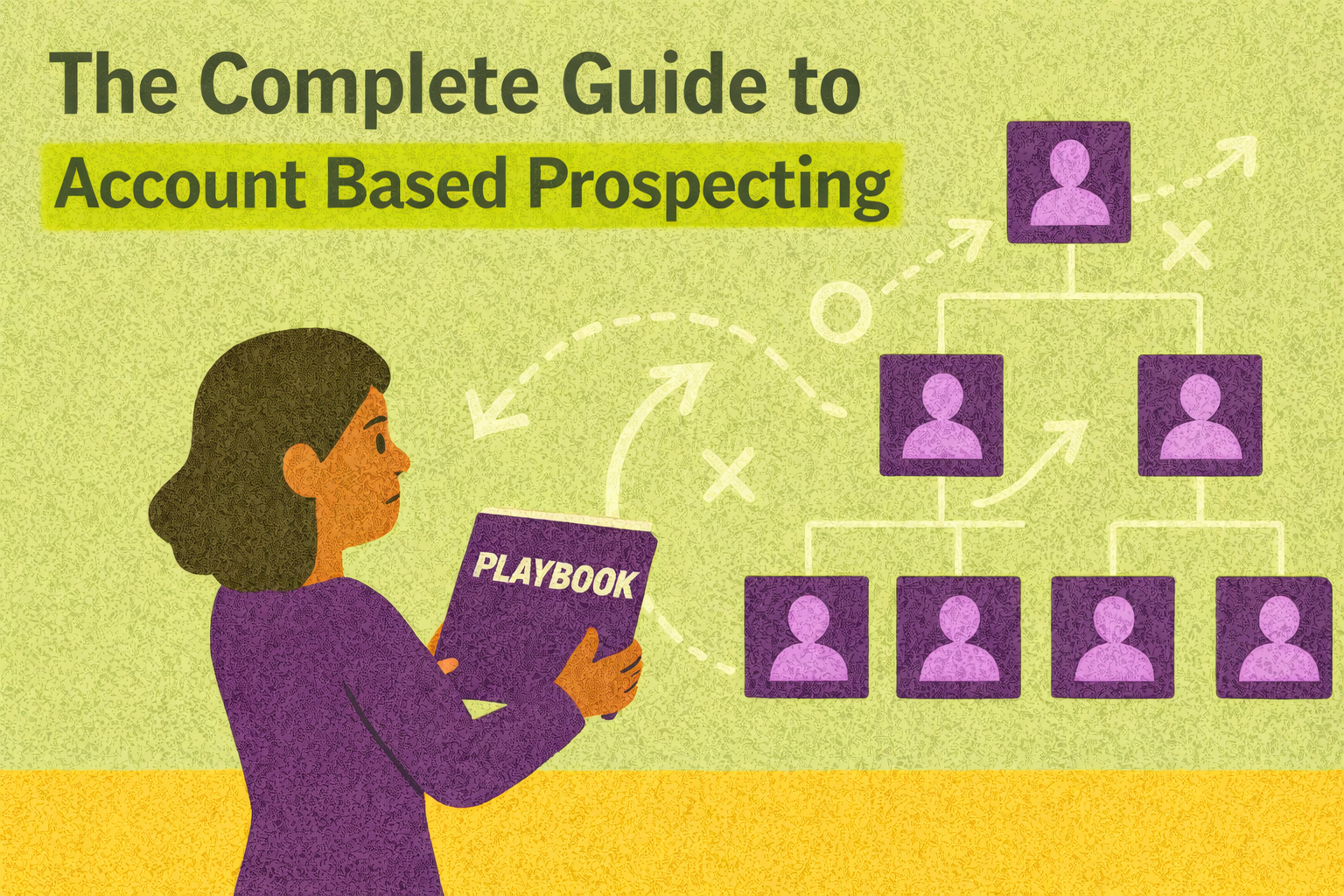
If you’re only reaching out to one person inside an account, you’re not really prospecting into that company. You’re prospecting an individual. Usually with the hope that the one person you picked happens to sit in the middle of a much larger buying group.
Account-based prospecting exists to solve this problem.
What is Account-Based Prospecting?
The best way to break into your “must have” accounts
Back in 2020, Challenger found that the average buying committee consisted of 5.4 people. This has only grown since. But, this number stands out because if you’re only reaching out to one person, you’re not even reaching 20 percent of the people involved in the decision.
That missing 80 percent is either a new opportunity to break into an account or an opportunity to create awareness often why deals stall or disappear.
Account-based prospecting starts with the understanding that you need to work the entire account, not just a single contact.
This is more involved than blasting emails, calls and LinkedIn DMs into your known persona at an account. It’s the act of working 1:1 throughout an entire account.
It starts with mapping the account, coordinating your approach for who will be prospected and when, creating persona and individual level messaging, connecting the dots across the account as you prospect, uncovering insights from within the org, and moving that information to the decision makers in power.
Account based prospecting isn’t a high scale approach. It should be reserved for your must have accounts. But, used properly, can be a hyper effective way to stand out and break into your must have accounts.
How to Map an Account the Right Way
An account is just a collection of individuals. When you’re working an account, you have to first map it to understand who are the likely individuals you’ll need to talk to and their relationship to one another.
A classic mistake I see teams make here is they assume that title is the only thing that matters. It’s a fair place to start, but influence doesn’t always map neatly against a VP vs. a Director title.
The classic visual for this is to look at a role like the assistant to the CEO. They own and manage the CEOs calendar. They have influence despite an assistant title. You’ll typically find that executives with less influence within the organization are easier to get responses from and get meeting time with. It’s important to note that these folks can be great entry points into the organization, but if you’re not multi-threading to multiple individuals within the account you’re risking relying on individuals that don’t have the influence you’d assume they have based on their title alone.
Sometimes, there’s someone in a middle management role who’s opinion is highly trusted. Past experiences of these individuals is a great place to start understanding their influence within the org. If they’ve been in the company for a long time, with a history of promotions, its fair to assume their influence is greater. They’ve had more time at the company to accrue political capital and trust.
Additional Resource from our Friends at Fluint: Account Planning that Doesn’t Suck
The Buying Power Line
When mapping an account, there’s an important line to draw, the buying power line.
- Above the line are the people likely making the final decision
- Around the line are influencers (these are the folks you might assume have influence but don’t own the budget)
- Below the line are the individual contributors who will use or be impacted by what’s being purchased
How you reach out above the line should look very different from how you reach out below it.
Buyers, Influencers, and Individual Contributors
Buyers are typically VP-level or higher. Influencers often sit in senior management roles. Individual contributors are the people who experience the product or service day to day.
The days of executives buying tools that people don’t use are over. ICs have real influence, and ignoring them is a mistake.
If you don’t know how to map an account, look at past deals. Who was referenced in calls? Who came up during purchase conversations? Call transcripts are one of the best resources for understanding how buying committees actually form.
From Account Mapping to Execution
Mapping an account only matters if it changes how you act.
Once you’ve identified buyers, influencers, and individual contributors, the biggest mistake sellers make is treating everyone the same. They either reach out to everyone at once or send seemingly identical messaging regardless of where someone sits in the organization.
The moment an account is mapped, your job shifts from finding contacts to deciding how each person should be worked.
People below the buying power line or near the buyering power line are often the best place to start. Not because they make decisions, but because they experience the problem directly and are more willing to share context. You also have a high chance of pulling someone into your orbit that has influence.
The insights you gain as you have conversations within the account have to shape how you reach out to influencers and buyers.
You’ll want to keep the latest context in mind as you reach out to the next person on your account plan. Name dropping, insight dropping, etc are all critical elements of effective account based prospecting.
Account-based prospecting works best when you work the account in waves, learn, adjust, and then expand. You might find low success below the line, so change your messaging and adjust, or you might see the middle layer is more responsive, use what you hear here to go back below the buying line to get more insights.
Multi-Threading the Account
Multi-threading has become a term with multiple definitions. Multi-threading is typically viewed by channel. You should absolutely be reaching out to each individual via multiple channels. Calls, emails, LinkedIn, and marketing touches (webinar invites, ads, etc) can work together to instill reciprocity with the person.
For the purpose of Account Based Prospecting, you need to think about multi-threading throught the lens of reaching out to multiple people within the account at the same time and utilizing the conversations and the people you’re reaching out to to amplify the “surround sound” effect that you should be looking to create.
Multi-threading creates multiple conversations connecting you to the account. When deals are active, having more than one thread dramatically increases your odds of moving the deal forward because if one contact creates a dead end, you’ll have additional other contacts that you can work with to create progress.
Tactic: Referral-Based Multi-Threading
One of the most effective ways to multi-thread is using a referral request as a bridge to another persona, and then using that referral request to bridge your next outreach.
Example: Chad -> Sasha
Use this as your last email in a sequence/cadence
Hey Chad, would Sasha be a better person to talk to about this? I realize RevOps might own tooling.
You can then follow up with Sasha: Use this as the first email in a new sequence
Hey Sasha, I’m not sure if Chad shared my note. I noticed…
From there, the rest of the email can be a normal cold email. Name drops and threaded outreach like this are the difference between basic prospecting and account-based prospecting.
You can also use this as you personalize outreach across the account,
Example: Active Conversations
Hey Chad, I had a quick call with Sasha last week about pipe gen goals. She mentioned your team was focused on a different segment but also had some big goals for next year. Think it makes sense to catch you up on our conversations?
Example: No Active Conversations (yet)
Hey Chad, I’ve reached out to a few folks on your team (Sasha, Nick, Julie, etc.) about personalization in outbound.
Given the recent team growth, I usually see personalization go to the backburner. Templates go out while they onboard, but results are suboptimal.
We’re helping teams with this problem and helping new sellers get better at bats. Think it makes sense to catch you up on what I wanted to talk to them about or is this just not the focus right now?
This is Unique Personalization at the Account Level
A classic mistake sellers make is only personalizing for the individual they’re emailing.
Buying is a team sport. If you’re not referencing what’s happening elsewhere in the account, what others are doing, saying, or struggling with, you’re failing to acknowledge the real situation.
Another Example: Account-level personalization with individual-level personalization to reach out "above the line"
Joan, I was catching up with Sarah in the BDR org. She mentioned the team has been struggling to personalize and touch enough accounts.
Given your team growth, I’m hearing you’re trying to find volume. Coaching to this can be a challenge. Acme, now at 20 percent plus reply rates, struggled here. Templates worked for some, but not others.
Know you’re just getting into role. Imagine you’re setting up programs from when you were at ApexBot. Would it help if we can help give you a deeper look at why things work versus don’t in email.
Would be great to hear what initiatives you’re putting in place to work on the problems Sarah pointed out. I can share what we’ve seen work vs. common pitfalls.
This moves from having a reason to reach out to having a point of view on the business.
Note: You’ll notice this additional personalization creates added length to the messaging. While this separates itself from our best practices, thoughtfulness and clarity are key. Its important to show your work so they know you’re reaching out 1:1. Use Lavender’s Email Coach to hone in these longer messages to ensure your message is still easily understood. It also makes it easier to find those 1:1 personal details to further personalize the message.
Adapting Messaging by Persona
Different personas have different jobs to be done. They own different metrics and goals. While they may all support the same end goal, how they experience problems day to day is very different.
One framework can work for one persona and fall completely flat for another. It’s important to create nuance in how you describe the problems faced and the value provided by the product or service when reaching out the different individuals.
Note: If you’re using Ora, this can be a great opportunity to edit the value propositions by persona within your campaign, or to split the persona into an entirely different campaign. Ora will write the emails to the 1:1 individual, but the reasoning and messaging will hinge on the training section, so giving the agent more to work with will improve your campaigns.
Let’s look at two messages that will show you the nuance of messaging. The first to a manager with direct reports (frontline leader) and the second message to a director that the manager reports to (second line leader).
Example: Frontline Leader
Chad, you’ve been on a hiring tear. Selling into a technical persona, imagine email is key. As you coach, would it help to know why some reps do well with email versus others?
Example: Second-Line Leader
Sarah, you’ve been on a hiring tear. Selling into a technical persona, imagine email is key to pipeline contribution as folks like Chad are coaching reps.
Would it help if everyone had clarity on why email works for some over others?
The messages have slightly different approaches to describing the problem and the value offered. These slight differences are the key to helping the recipient connect with why the message is relevant for them, not just the “problem” in general.
Working the Account Over Time
Deliverability 101: Don’t Reach Out to Everyone at Once
Blasting the entire account at once backfires. You should only reach out via email to one person in the account per day. This can be a great opportunity to weave in multiple channels. An email to one person, a connection request to another, a few DMs to a few people, and a few cold calls across the account can create the surround sound you need without landing you in spam.
It’s also important to nuance the messaging as you work across the account. There’s nothing more awkward than two team members referencing your email and realizing the email was the exact same. You’re better than this ;)
If you'd like to learn more about deliverability, check out our complete guide to deliverability here.
Waterfalling the Account
Waterfalling means:
- Working above-the-line contacts progressively working your way down to the buying line
- Being a journalist with one-to-one below the line messages
- Waterfalling insights uncovered back down the org chart as they’re found
Prospecting Below the Line
If you hear “I don’t make those decisions,” you’re likely sending above-the-line messaging to someone below the line.
Below-the-line personas are often on a maker schedule. If you’re not familiar with Maker vs. Manager schedules, check out this Paul Graham Essay. A maker is someone who is doing the work, so they are not typically in meetings. Managers on the other hand are in meetings all day. Makers need focus time and fewer meetings. This changes both why you reach out and how often you do it.
Cadence Rules Below the Line
- Frequency: create more time between each touch point
- Duration: End the sequence after 2-3 touchpoints
- Messaging: Your goal is to learn and help > sell
Here’s an example sequence for someone below the line.
Email 1: Helpful Intro
Sarah, saw your team is on SalesLoft. Curious if Joan has your team personalizing much of your cold email. Happy to send over a few things we’ve seen work.
Email 2: Neutral Insight Follow-Up
Sarah, did you catch the “30 Minutes to President’s Club” collab with Charlotte Johnson?
With your team on SalesLoft, thought you might find it useful. Is your team doing much personalization there?
Email 3: Clarify and Come Clean
Hey Sarah, I was going to reach out to Joan, but wanted to make sure I understood how your team approaches email first.
We’ve built a sales email coach inside SalesLoft that helps reps average 20 percent plus reply rates. Think this could help your team?
If there’s no response after this, move on.
Warm Introductions and the Forwardable Email
Who are you more likely to respond to, a stranger or someone you know?
There’s an unwritten cheat code for getting warm connections to make introductions for you, and it’s called the forwardable email. The goal is to make it easy for someone else to introduce you without friction or awkwardness.
This approach works in cold outreach, multi-threading, and general networking.
This tactic can be a killer way to open up new conversations within the org. But, there’s an unspoken ettiquet to the tactic.
Step 1: Ask the Connector
Start by emailing the person you already know. Keep it short.
You’re asking:
- How well they know the target
- If they’d be open to making an introduction & why
You should also include one to two sentences on why the target would get value.
Example: Connector Ask Email
Hey Kara,
I noticed you’re connected to Sarah. Do you know her well enough to make an introduction?
I think she’d get value from a quick conversation around how teams are approaching email personalization at scale. If you’re open to it, I can send over a forwardable note.
Step 2: Write the Forwardable Email
This is the email the connector will forward. You'll send it to the person to forward along.
It should include:
- One sentence on why the target should care
- Two to four sentences as a short elevator pitch
Example: Forwardable Email
Hey Kara,
I was talking to a few folks on Sarah’s EMEA team. Open to bridging an intro?
Seems like personalization is an org wide initiative. Folks typically take linear approaches to this, and thought Sarah’s NA team would find it as interesting as the EMEA group did.
Our agent’s are using a full reasoning layer with multi trigger research to craft 2-4x better emails. Thought she’d want to see how we could integrate it into their Gong set up.
Mind sending this over to her to see if there’s interest?
Note: The forwardable doesn’t reference your past conspiring. You treat it as if they haven’t agreed. This way the connection when forwarded reads as a natural note. You don’t have to take this approach, but I’ve found when forwarded this creates better logic for “Sarah” to catch up on the logic.
Another Note: When the email is forwarded, you should not be included. Including yourself puts the target in an awkward position where they feel pressured to respond.
If they’re interested, the connector will make the introduction.
Step 3: Spare Their Inbox
Once introduced:
- Thank the connector
- Move them to BCC
- Let them know you’ll keep them in the loop
Example: Post-Introduction Reply
Thanks so much for making the intro, Kara. I’m going to move you to BCC here and will keep you posted as things progress.
Step 4: Follow Up
After you’ve connected, follow up with the connector and keep them informed. This is what turns one introduction into many.
Reaching Executives Without Burning Bridges
Sometimes you know who the executive buyer is, but can’t see a clear path to them. Usually this happens when your contact doesn’t feel comfortable looping in the person, or they don’t feel like it’s a big enough priority to push for time on their schedule.
It’s important you get to “power” in your deals. So there’s some key tactics you can use to avoid burning bridges without getting into an awkward permissions struggle.
The goal with looping in executives early on isn’t to become “another” meeting. Instead you should look to be building value with them. This starts by keeping them in the loop on things happening below the line. But, as conversations progress, you have the opportunity to lift up how great their people are while also keeping them informed on progress.
Executives want to feel they’re in control. So, keeping them looped in without making an ask is a great way to stay top of mind.
There’s two good rules for this multi-threading tactic to keep in mind:
- Don’t ask permission
If they haven’t told you to not contact someone, why give them a reason to. Take a read from your conversation if the contact wants to naturally pull them into the fold, great. If they don’t, you’ll need to naturally loop them in. - Don’t burn bridges
You’re reaching out without permission. So, you want to make sure your note doesn’t burn your contact’s political capital. You can simply compliment your contact in your outreach to the executive to create safety in this tactic.
Your goal is to get the executive involved with this outreach. But, you’re doing so by keeping them informed on progress. You aren’t asking them to be involved. If you’re touching on a high priority item, you’ll naturally create pull that will get them interested in being involved.
Here’s an example of how you can keep them in the loop.
The No-Ask Executive Update Email
Hey Will,
Joan Smith and I have been talking enterprise pipeline generation. She’s put strong systems in place to ensure process adoption. Great hire!
Looks like there’s some great opportunities to tweak how reps are writing emails (we have a lot of data here). We also found a great opportunity to automate account and individual research.
We’re running a test over the next couple months with a goal of moving reply rates from 4 percent toward our 20 percent average.
Wanted to keep you in the loop given Joan mentioned the team was behind on goal here. No need to reply - I’ll keep you posted.
PS, if there are higher-level initiatives I’m missing, I’d love to make sure this supports your goals.
This message does some simple things. It starts with a name they know. It touches on an initiative that matters, fills them on your work together, and finishes with a low pressure opportunity for them to engage.
These Are The Tools… Now Go Work The Account
This isn’t a scalable tactic. It’s a system for getting your must have accounts to start responding to you. It requires work in order to work.
If you put in the work, ensure these contacts know the efforts your putting in to reach out to each of them individually, you will become an undeniable conversation within the account. They may tell you “not now” but you will find response and you will eventually find a path “in”.
If you want to dig deeper on this topic and more, be sure to get certified on Lavender’s Cold Email Wizard 201 course where we cover these topics even further.