
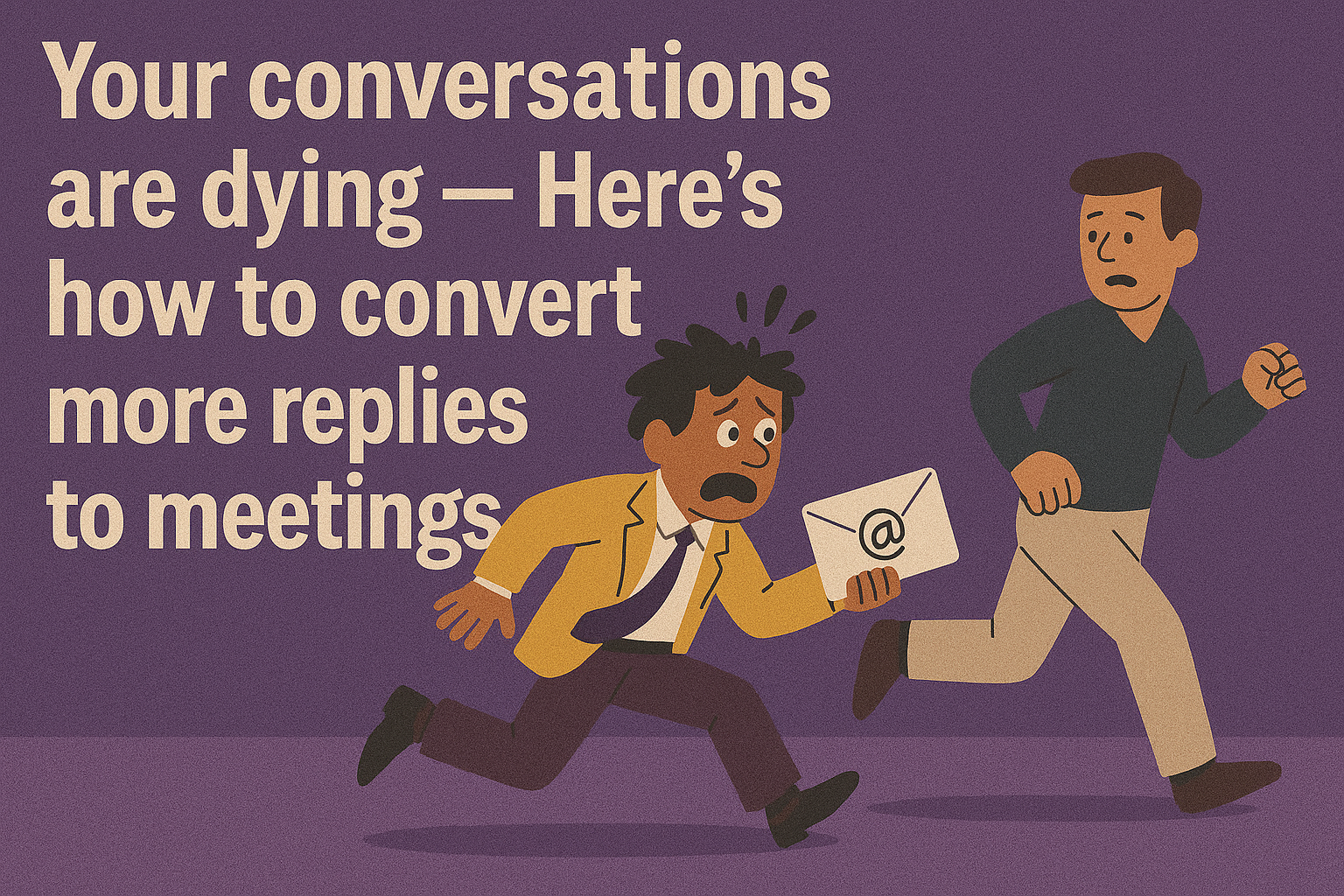
Your conversations are dying. Here’s how to convert more replies to meetings
If you follow what we’ve been teaching, you’re going to get more replies.
Most people think they know how to reply to emails. Beware of this false confidence. Here’s the truth: a quarter to half of the email threads you’re on likely go cold because of one simple thing.
In this blog, we’ll start with the data, explain the psychology behind why threads stall, and then show how to bring it to life with real reply examples.
The Data: Why Email Velocity Matters
Want to know the number one correlator to deals being won?
It’s email velocity. Email velocity is the rate at which emails are going back and forth with your prospect.
Gong has posted some great data on this. According to Gong’s analysis of hundreds of thousands of deals, the number of emails exchanged back and forth is the strongest indicator of whether a deal is won or lost. When threads die, reps chase. When reps chase, opportunities disappear.
At every step in a deal, you should be trying to increase the odds that the conversation continues.
If your email threads die, your chances of losing the deal skyrocket.
Why Email Threads Actually Die
Most threads die for one simple reason:
You stopped asking questions.
Based on our analysis of billions of sales emails, the vast majority of emails after the reply includes zero questions. None.
That’s a big problem.
If you want a reply back, you should be asking several questions (2-4 ideally). Our data consistently shows this can improve post reply response rates 25-50%.
Curiosity Is the Skill You’re Missing
So what’s really going on?
You’re not curious enough.
You should almost always be asking:
- Why they asked a specific question (what’s the objection behind the objection?)
- What context might be missing
- Whether your understanding is correct
- Whether anyone else should be involved
- If there’s alignment on next steps
- What else you could bring that might be helpful
Discovery isn’t a call. It’s not a CRM stage.
Discovery is a mindset.
Top sellers constantly look around corners. Curiosity is one of the most reliable traits shared by high performers.
Cold Email Reply Scenarios (With Examples)
Let’s bring this to life with real examples. Let’s say this is your cold email:
The Cold Email
Congrats on hiring, Joan. Coming off your time at Acme, I imagine you have a playbook for how they’ll ramp.
Usually our customers focus training on phones, but email results lag. Apex, now at 20%+ reply rates, struggled to coach here. Templates worked for some, but not others.
Our in-inbox coach helped them level up — open to seeing how?
Scenario 1: Interesting, but delegated
Response From Prospect
Hey Will —
Great email. Seems interesting. You should reach out to Susan in RevOps.
— Joan
Reply 1: The Reply That Kills the Deal
Thanks, Joan. Will do.
Don’t do this.
This is a fast track to chasing a lead you’ll never hear from again. You’ve removed momentum and learned nothing.
Reply 2: Better, But Still Incomplete
Great. Including her on the thread here.
@Susan — see context below. Open Thursday to connect.
This is better. Looping in Susan is a pro move.
But you’re still missing critical context that would help the eventual conversation.
Reply 3: The Curious Reply (Preferred)
Guessing that’s because Susan runs tooling?
Can do — though I usually work closely with sales leadership as we get closer to a decision. No stranger to RevOps, just wanted to make sure I understood.
Mind making an intro? I can also add her to the thread if easier.
This approach:
- Opens the door to deeper context
- Clarifies how decisions are made
- Creates a natural next step (looping in Susan)
If you don’t get a reply, then it’s natural to add Susan yourself.
Scenario 2: “Not Interested”
Not every response will be positive. Unless they just say “unsubscribe” there’s an opportunity to dig deeper.
Prospect Reply
Great email, but not a good time right now. Thanks.
This often gets marked as “Not Interested.” That’s a mistake.
Reply 1: What Most People Do (Wrong)
No response at all.
Don’t do this.
You got a reply — lean in.
Reply 2: Weak Follow-Up
Would there be a better time to follow up?
This gives them no reason to respond.
Reply 3: Curious Follow-Up (Preferred)
Mind sharing why?
Usually when teams are ramping, we see enablement gaps show up in writing data. Is email not a big part of pipeline generation? Or is the team not tweaking templates much?
If it makes sense to talk to someone closer to the work, let me know — and feel free to tell me I’m totally missing the mark.
This won’t always get a response.
But when it does, you learn a lot:
- How they think about your category
- Where objections actually live
- How to tailor future conversations
Even silence here can still make you better on the next outreach.
Scenario 3: The Email Moves to Scheduling
Sometimes things move fast.
Prospect Reply
Interesting email. Let’s find some time next week.
Reply 1: Calendar-Link Only (Don’t Do This)
Sounds good — here’s my calendar link.
This can rub people the wrong way. It’s one-sided and transactional.
Reply 2: Time Windows Only
How’s your schedule Monday or Tuesday? I’m open 2–3pm EST both days.
Better — but there’s still a stronger option.
Reply 3: The “Triple Option” (Preferred)
Great. Including some time windows below (Eastern):
Monday: 1:00–1:30, 3:00–3:30
Tuesday: 10:30, 4:30–5:00
Anyone else I should include on the invite?
Including my calendar link if easier — happy to use yours if you prefer.
P.S. Anything from my email you want to make sure we cover? I can prep an agenda.
This works because it:
- Gives time options
- Offers flexibility
- Encourages collaboration
- Gathers intel before the call
The questions increase your odds of multi-threading and walking into the meeting prepared.
Final Thought: Don’t Be the Average Emailer
Most sellers stop at answering.
Top sellers stay curious.
If you apply this mindset — asking better questions at every stage — you’ll find yourself in more conversations, with more momentum, and far fewer dead threads.
Stay curious.
Keep asking questions.
Want to dig deeper? Get Lavender certified in the Lavender Cold Email Wizard Course.
Email 101 and 201 are free!